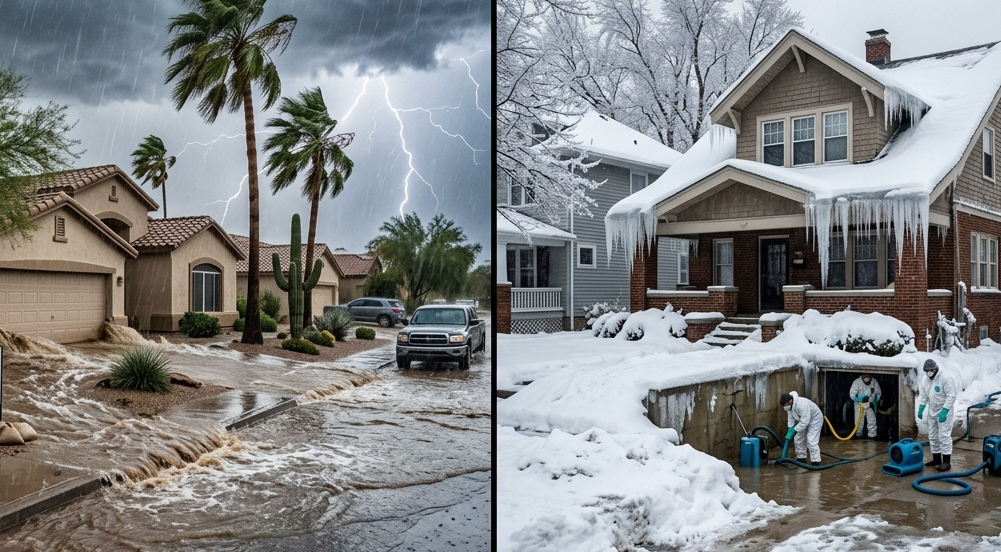
Phoenix and Cleveland sit at opposite ends of the American climate spectrum. Phoenix averages 299 sunny days per year and less than 8 inches of annual rainfall. Cleveland averages 65 cloudy days in a row during winter and over 60 inches of combined precipitation and snowfall annually. These two cities could not be more different environmentally – and yet homeowners in both markets face serious, recurring water damage events that require professional restoration.
What changes between Phoenix and Cleveland is not the urgency of the response. It is the source of the water, the materials at risk, the drying timeline, and the secondary damage that follows if response is delayed. Understanding those differences helps homeowners in both cities make faster, smarter decisions when water damage strikes.
How Phoenix Gets Water Damage: Monsoon, Pipes, and Hidden Moisture
Phoenix’s reputation as a desert city leads many homeowners to underestimate their water damage risk. In reality, the Valley of the Sun produces several distinct water damage scenarios that catch residents off guard repeatedly.
Monsoon flash flooding is the most dramatic. Arizona’s summer monsoon season runs from June 15 through September 30, and the storms it produces are nothing like the gradual rainfall of wetter climates. Desert soils have extremely low absorption capacity – years of dry conditions create a near-impermeable surface that sheds water rapidly rather than absorbing it. When a monsoon cell drops 1–2 inches of rain in 30 minutes, the water has nowhere to go except across streets, through yard drainage systems, and in many cases through garage doors, window wells, and low-entry-point doors into homes.
The National Weather Service Phoenix office identifies flash flooding as the leading weather-related cause of death in Arizona – a statistic that underscores how seriously this market takes rapid water intrusion events.
Plumbing failures under extreme heat are a year-round Phoenix risk that most of the country does not face. Sustained summer temperatures above 110°F cause supply line hoses, braided steel connectors, and plastic pipe fittings to expand, stress, and fail at significantly higher rates than in moderate climates. A refrigerator ice maker line or washing machine supply hose that would last 10 years in a moderate climate may fail in 5–7 years in Phoenix’s heat.
Hidden moisture behind low-absorption surfaces is Phoenix’s most insidious water damage mechanism. Tile and stucco – the dominant exterior and interior finish materials in Arizona construction – do not show moisture intrusion visibly until saturation behind them is severe. A slow leak behind a tile shower wall or under a slab can run for months in Phoenix before producing any visible sign, while mold grows in the microclimate of the wall cavity.
How Cleveland Gets Water Damage: Freeze-Thaw, Lake Erie, and Basement Hydrostatics
Cleveland’s water damage profile is driven by the opposite climatic extreme – too much cold, too much moisture, and a Great Lakes weather engine that produces snow events of a scale Phoenix residents would find difficult to imagine.
Freeze-thaw pipe failures are the most common winter event. Northeast Ohio temperatures cross the freezing point repeatedly throughout the winter season, expanding and contracting water in pipe runs located in exterior walls, unheated crawl spaces, and attic spaces in older construction. When a pipe freezes and then thaws, the ice-expanded material stresses the pipe wall – and the burst typically happens during the thaw, not the freeze, releasing full line pressure into the structure.
Lake-effect snowmelt flooding is Northeast Ohio’s version of Phoenix’s monsoon – a rapid, high-volume water event that overwhelms drainage systems quickly. Lake Erie’s shallow depth allows it to generate lake-effect snow bands rapidly, depositing 12–24 inches of snow within hours. When temperatures subsequently rise, the melt rate exceeds ground absorption and drainage capacity simultaneously, producing basement flooding from hydrostatic pressure through foundation walls and floor slabs.
Freeze-thaw foundation cracking creates long-term intrusion pathways that worsen every winter. Water in foundation cracks expands as it freezes, widens the crack, and creates a larger channel for the next melt cycle. Cleveland homeowners dealing with their first significant basement flood in an older home are often experiencing the cumulative result of decades of this process.
Certified specialists providing Cleveland OH flood restoration are structured specifically for these events – equipped for rapid basement extraction after snowmelt events, freeze-thaw structural assessment, and the specific pipe failure patterns that Northeast Ohio winters generate in pre-1970 housing stock.
The Drying Timeline Difference: Where Phoenix Has an Advantage – and a Hidden Risk
In water damage restoration, drying speed matters enormously. The faster structural materials reach target moisture content, the less secondary damage occurs. And this is where Phoenix’s climate creates a genuine advantage over most of the country – including Cleveland.
Phoenix’s extremely low ambient relative humidity (often 10–20% in summer outside monsoon events) means that materials release absorbed moisture rapidly into the dry air column. Industrial dehumidifiers and air movers work with the climate rather than against it. A drying project that takes 4–5 days in humid Cleveland or a coastal market can sometimes complete in 2–3 days in Phoenix under the right conditions.
However, this creates a deceptive risk: materials that appear dry in Phoenix may not be dry. When ambient humidity is very low, surface moisture evaporates rapidly while moisture deeper in the material cross-section migrates more slowly toward the surface. Moisture meter readings taken only at the surface in a Phoenix drying project can show acceptable numbers while wall cavity moisture content remains elevated. Daily deep-probe moisture mapping is essential in this market – not just surface readings.
In Cleveland, the opposite dynamic applies. Higher ambient humidity slows moisture release from materials, extending drying timelines but also making subsurface moisture more visible in readings because the gradient between saturated material and ambient air is less extreme.
Mold Risk: Two Different Timelines, Same Consequence
Both Phoenix and Cleveland homeowners face mold risk after water damage – but the mechanisms differ.
In Phoenix, mold is counterintuitive. The outdoor climate is too dry to support significant outdoor mold populations. But inside a water-damaged wall cavity with trapped moisture, the microclimate is entirely separate from outdoor conditions. Mold initiation in a sealed, moist Phoenix wall cavity can begin within 24–48 hours regardless of outdoor humidity. And because Phoenix homeowners often assume the dry climate protects them, they are more likely to delay calling a restoration company – giving mold the time it needs to establish.
In Cleveland, the risk is more expected but equally aggressive. Northeast Ohio’s high ambient humidity during spring and summer – the peak snowmelt and storm season – means the drying window after a water event is short. Unaddressed basement flooding in Cleveland during April or May produces visible mold within 3–5 days in many cases.
Both markets: the IICRC S500 Standard for Professional Water Damage Restoration sets the industry response baseline. IICRC-certified contractors in both Phoenix and Cleveland provide daily drying logs, moisture mapping, and a final clearance certificate before any rebuild work begins. These documents are your protection against mold disputes months after restoration appears complete.
The Slab Difference: Phoenix Under-Slab Leaks vs. Cleveland Hydrostatic Pressure
Both cities have high rates of slab-on-grade construction – but for different reasons and with different failure modes.
Phoenix builds on slab almost exclusively because frost-depth basements are unnecessary in a climate that rarely freezes. Under-slab plumbing failures (slab leaks) are endemic to the market because Arizona’s soil composition shifts significantly with moisture changes, stressing buried copper pipe over time. A Phoenix slab leak can run undetected for months, saturating the slab from below and wicking moisture up through tile grout joints.
Cleveland’s slab failures are rarer but more dramatic – hydrostatic pressure events where groundwater under the slab rises to the point of forcing water up through floor drain connections and slab cracks during snowmelt events. These events flood the entire basement floor simultaneously rather than through a single leak point.
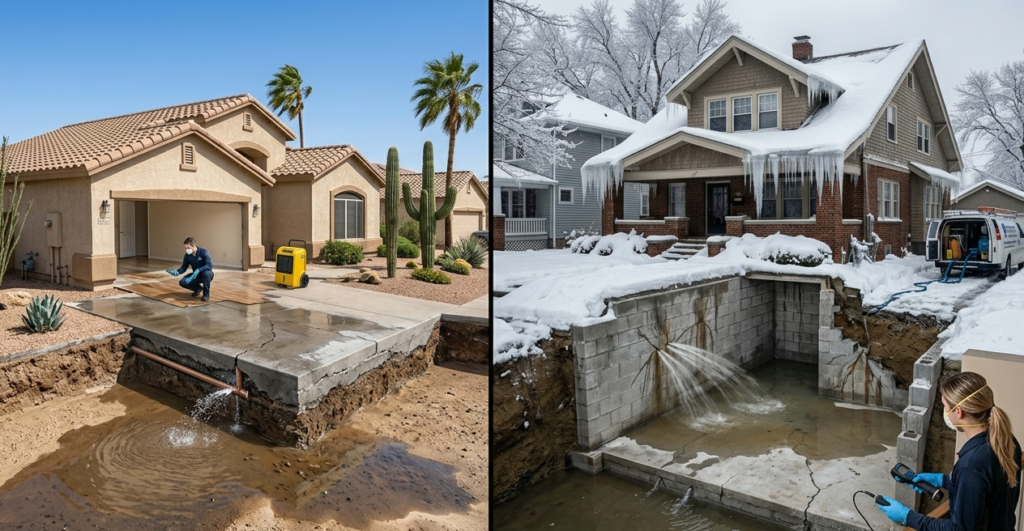
Both scenarios require professional moisture mapping to determine the full extent of saturation – and both require identifying and repairing the source before any flooring or slab restoration work begins.
Insurance Considerations in Both Markets
Both Phoenix and Cleveland homeowners frequently encounter the same insurance coverage gap: standard homeowners policies do not cover groundwater flooding.
In Phoenix, monsoon flooding that enters from outside the structure – through doors, foundation gaps, or yard drainage – is typically not covered under a standard homeowners policy. Coverage requires a separate flood insurance policy through FEMA’s National Flood Insurance Program or a private flood endorsement.
In Cleveland, basement flooding from hydrostatic pressure through foundation walls is similarly excluded from standard coverage in most policies. Water backup endorsements cover sewer backup events but not groundwater intrusion.
Review your declarations page carefully before monsoon season in Phoenix – and before snowmelt season in Cleveland. The coverage gap is the same in both markets even though the climate that creates it is opposite.
Conclusion
Phoenix and Cleveland are climatically opposite – but both cities produce serious, recurring water damage events that require fast professional response. The source of the water differs. The building materials differ. The drying timeline differs. What does not differ: acting within the first two hours, documenting before touching anything, and hiring an IICRC-certified restoration contractor who understands your specific market’s failure patterns.
Water Damage Repair Phoenix serves Phoenix, AZ and the entire Valley of the Sun with 24/7 emergency response, flood extraction, structural drying, mold remediation, and monsoon damage restoration. IICRC-certified. Licensed and insured.
Call: (602) 804-0118
Leave a Reply