
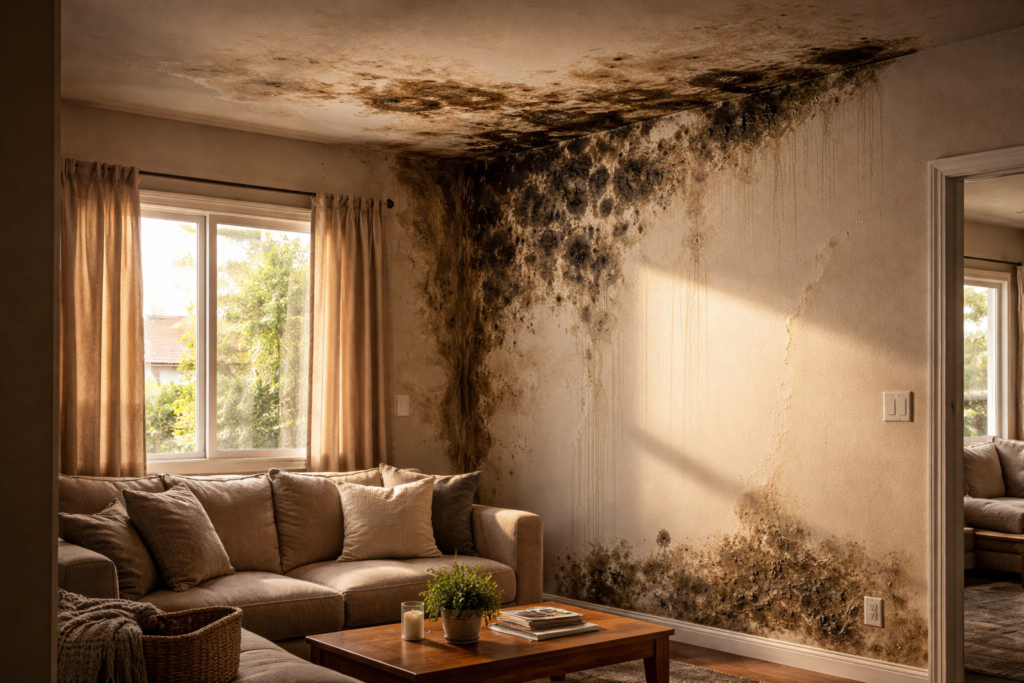
Despite our famous dry heat and desert climate, Phoenix homes are just as susceptible to mold growth as homes in humid coastal cities. In this comprehensive guide, the experts at Water Damage Repair Phoenix will break down the timeline of mold growth, explain why the desert climate won’t protect your home, and provide actionable steps to save your property.
The Golden Rule: The 24 to 48-Hour Window
In the restoration industry, the first 48 hours after a water intrusion are known as the “golden window.” Microscopic mold spores exist naturally in the air, both indoors and outdoors, all across Arizona. Under normal conditions, these spores are completely harmless. They float through the air, waiting for the right conditions to settle and multiply.
To thrive, mold needs three things:
- Oxygen: Always present.
- A Food Source: Organic materials like drywall, wood, paper, carpet, and insulation.
- Moisture: Introduced via a leak, flood, or high humidity.
When water saturates your drywall or carpets, you have essentially created an all-you-can-eat buffet for mold spores. Once the spores make contact with the wet surface, they begin to germinate in as little as 24 to 48 hours. If the moisture is not removed rapidly and professionally, these spores will quickly grow into a full-blown colony.
The Phoenix Paradox: Why the Desert Doesn’t Stop Mold
A common and dangerous misconception among Arizona homeowners is that mold cannot grow in the desert. The logic seems sound: mold loves humidity, and Phoenix has almost zero humidity for most of the year.
However, this logic ignores the reality of indoor microclimates.
When it is 115°F outside in July, your home is sealed tight, and your air conditioner is working overtime to keep the indoor temperature at a comfortable 74°F. If a pipe leaks inside a wall cavity, the water doesn’t evaporate into the dry desert air. Instead, it becomes trapped in the dark, cool, insulated space between your drywall and studs.
In fact, the extreme Phoenix heat can actually accelerate mold growth. The sun bakes the exterior of the house, raising the temperature inside the wall cavity just enough to create a warm, humid, terrarium-like environment-the exact conditions black mold (Stachybotrys chartarum) and other toxic molds need to flourish.
The Exact Timeline of Mold Growth After Water Damage
Understanding how mold develops can help you understand why time is of the essence when dealing with water damage. Here is the chronological timeline of what happens inside your Phoenix home after a water leak:
Minutes to 24 Hours: The Saturation Phase
Water spreads rapidly. It follows the path of least resistance, soaking into porous materials like carpeting, padding, baseboards, and drywall. Water can wick up a drywall panel at a rate of an inch per hour. During this phase, mold spores are settling onto the damp surfaces and absorbing the moisture. No visible mold is present yet, but the clock is ticking.
24 to 48 Hours: The Germination Phase
This is the critical window. The settled mold spores begin to germinate and form hyphae (microscopic root-like structures). These roots dig into your drywall and wood, searching for nutrients. You likely still cannot see the mold, but you might begin to notice a faint, musty odor in the affected room.
3 to 12 Days: The Colonization Phase
By day three, the mold is actively reproducing and colonizing. You will likely begin to see visible signs of growth. It may look like black, green, or white specks on your baseboards, walls, or ceilings. The musty odor will become much stronger. Because the mold roots have embedded themselves into the porous materials, simply wiping the surface with bleach will no longer solve the problem; the roots will survive and the mold will return.
12 Days and Beyond: Structural Damage and Health Risks
If left unaddressed for nearly two weeks, the mold colony will mature and begin releasing millions of new spores into your home’s HVAC system, cross-contaminating other rooms. The mold will begin digesting the organic materials it lives on, causing drywall to crumble and wood studs to rot, compromising the structural integrity of your home. At this stage, inhabitants may begin experiencing severe respiratory issues, allergic reactions, and fatigue.
Common Causes of Water Damage and Mold in Phoenix
At Water Damage Repair Phoenix, we have seen it all. While we don’t have hurricanes, Phoenix homes face unique plumbing and weather challenges that frequently lead to mold:
- Monsoon Storms: From June to September, violent microbursts and heavy rains can exploit compromised roofing shingles, leading to severe attic and ceiling leaks.
- Air Conditioning Leaks: Because AC units run almost year-round in Arizona, condensation line clogs and drip pan overflows are incredibly common, often causing silent water damage in attics or utility closets.
- Slab Leaks: Many Phoenix homes are built on concrete slabs. The intense heat and shifting desert soil can cause underground copper pipes to corrode and burst, pushing water up through your flooring.
- Water Heater Failures: Hard water is a major issue in the Valley. Calcium and magnesium buildup can cause water heaters to rust and rupture prematurely, flooding garages and adjacent living spaces.
- Appliance Supply Lines: Plastic supply lines to refrigerators, dishwashers, and washing machines frequently crack and leak behind cabinets where they go unnoticed for days.
Hidden Signs You Have a Mold Problem
Because water often leaks in hidden areas-behind cabinets, under floors, or inside walls-mold can grow unnoticed. Keep an eye out for these subtle signs of hidden mold growth in your Phoenix home:
- The “Musty” Smell: This is often the first indicator. If a room smells damp, earthy, or like old gym socks, you likely have hidden mold.
- Peeling or Bubbling Paint: When drywall absorbs water, the paint will begin to bubble or peel away from the wall.
- Discolored Baseboards or Ceilings: Look for faint yellow, brown, or water-stained rings on your ceilings or walls.
- Unexplained Health Issues: Are you or your family members experiencing chronic coughing, sneezing, itchy eyes, asthma flare-ups, or headaches that magically disappear when you leave the house? This is a strong indicator of indoor mold exposure.
- Warped Flooring: Hardwood floors that cup or buckle, or tile floors that sound hollow when walked on, indicate trapped moisture underneath.
Why DIY Mold Removal is a Bad Idea
When homeowners spot a small patch of mold after a leak, the initial reaction is often to grab a bottle of bleach and a sponge.
First, bleach does not kill mold on porous surfaces like drywall; it only bleaches the color, making the mold invisible while it continues to grow underneath. Second, scrubbing mold aggravates the colony, causing it to release thousands of spores into the air as a defense mechanism. This turns a localized problem into a whole-house contamination issue.
Furthermore, if mold has appeared on the outside of a wall, it is almost guaranteed that the inside of the wall cavity is entirely covered in mold. Removing it safely requires industrial HEPA vacuums, negative air pressure chambers, and commercial-grade antimicrobial treatments.
What to Do If You Experience Water Damage in Phoenix
If you experience a water leak, swift action is your best defense against mold. Follow these steps immediately:
- Stop the Water: Shut off the main water valve to your home to prevent further flooding.
- Ensure Safety: Turn off the electricity to the affected areas if water is near electrical outlets to avoid shock hazards.
- Remove Standing Water: Sop up as much water as you safely can using mops and heavy towels.
- Create Airflow: Open doors and turn on ceiling fans to start circulating air, provided the outdoor humidity is low.
- Call the Professionals: Do not wait to see if the area dries on its own. Every hour counts.
Trust the Phoenix Water Damage Experts
Because mold can begin growing in as little as 24 hours, you cannot afford to wait. Fast, professional water extraction and structural drying are the only proven ways to prevent a water leak from turning into a toxic mold nightmare.
At Water Damage Repair Phoenix, we understand the unique challenges of the Arizona climate. Our highly trained, certified technicians are available 24/7 to respond to emergency water leaks. We utilize state-of-the-art thermal imaging cameras to find hidden moisture, commercial-grade dehumidifiers to dry your home to the studs, and EPA-approved antimicrobials to ensure mold doesn’t stand a chance.
Leave a Reply